Path 04 · Week 2 of 3
The Suppression Mechanism
Pronouns Part 2: How polite language became the tool we use to hold down what we already know is true.
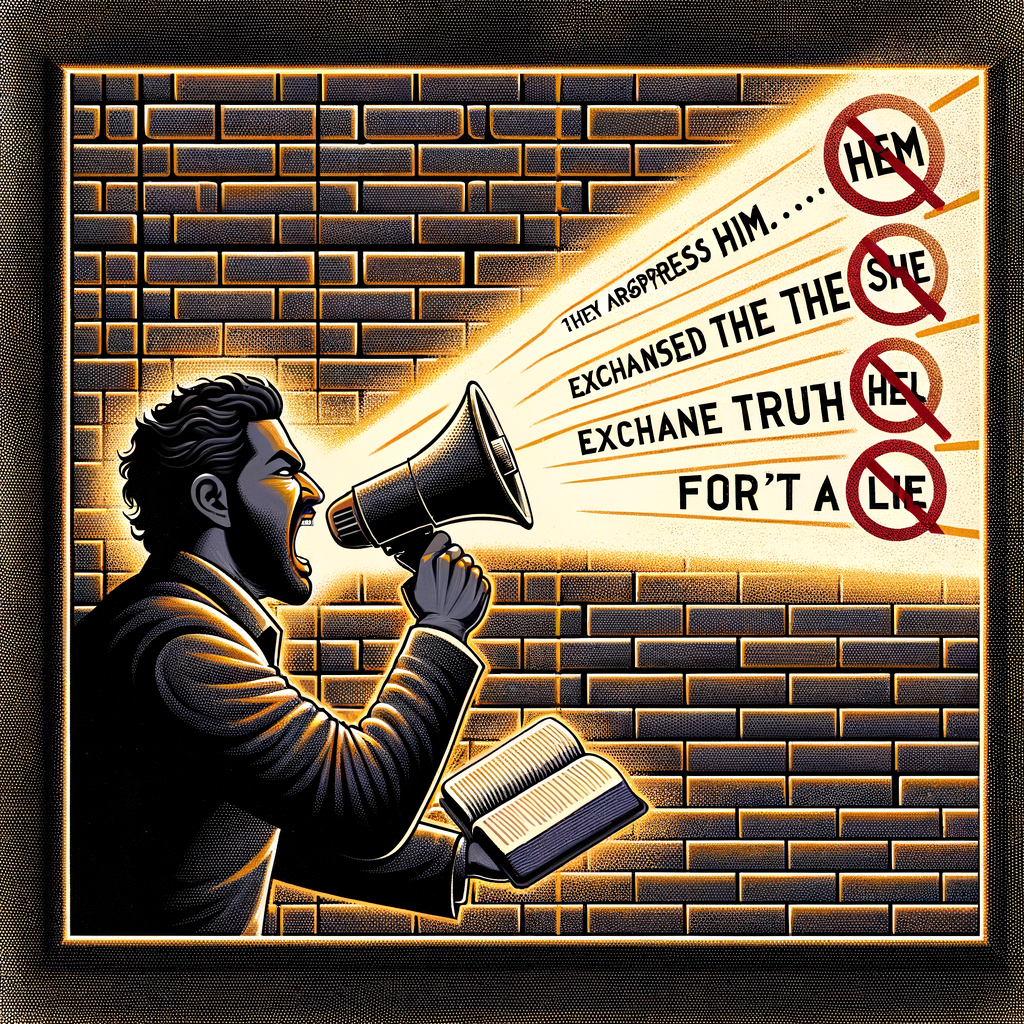
In Part 1, we briefly looked at what Romans 1 says is happening in our culture. The suppression of plain truth. The trade — swapping God’s design for the creature’s version. I want to go a little deeper into Romans 1 so you understand the underlying concepts at play.
The Active Suppression of Plain Truth (1:18–20).
The text zeros in on people who “by their unrighteousness suppress the truth” about God, even though “what can be known about God is plain to them” and has been “clearly perceived…in the things that have been made.” Nuance: This isn’t vague spiritual blindness—it’s deliberate holding-down of evidence that’s baked into creation itself. For the pronouns issue, that “plain” evidence is the male/female binary written into bodies, chromosomes, and reproduction (the very things “made” that reveal the Creator). Calling someone “she” when biology says otherwise isn’t neutral speech; it’s participating in the suppression mechanism. The text calls this unrighteous because it leaves people “without excuse.” The real situation here is linguistic gaslighting of observable reality—modern culture demands we deny what’s plainly perceivable, exactly as described.
The Double Exchange and Self-Idolatry (1:23, 25).
Twice the passage hammers the word “exchanged”: first “exchanged the glory of the immortal God for images resembling mortal man,” then “exchanged the truth about God for a lie and worshiped and served the creature rather than the Creator.” Nuance: This isn’t passive drift—it’s a conscious swap. The creature (human feelings, self-conception, autonomy) gets elevated to god-status while the Creator’s design gets discarded as a lie. Pronouns are the everyday sacrament of that exchange. By rewriting “he/she” to match internal identity instead of external biology, language itself becomes the tool for worshiping the creature. The nuance most miss: this isn’t just about sex or feelings—it’s idolatry of the self as the new definer of reality. The “real situation” is that demanding pronoun compliance forces everyone around the exchange to participate in creature-worship. Refusing isn’t unkindness; it’s refusing to bow.
The “gave them up” Progression to Dishonor and Debased Mind (1:24, 26–28).
Three times the text repeats “God gave them up” (or “gave them over”): first to “the lusts of their hearts to impurity, to the dishonoring of their bodies”; then to “dishonorable passions” where people “exchanged natural relations for those that are contrary to nature”; finally to “a debased mind to do what ought not to be done.” Nuance: This is God’s judicial handover—He removes restraint so the logic of the earlier exchange plays out fully. The parallel to pronouns is precise: the same “exchange” language used for natural vs. contrary relations now applies to natural sex vs. self-redefined identity. Pronouns become the public enforcement of that dishonoring—language must now serve the debased mind rather than reflect the created order. The outside-the-box layer: we’re not watching a neutral cultural shift. Romans 1 diagnoses the momentum behind gender ideology as divine abandonment in action. The confusion, the insistence, the social penalties for dissent—all flow from the debased mind that no longer sees fit to “acknowledge God.” That’s why it feels “obviously incorrect” to those holding the biblical view: it’s the text’s own diagnosis of what a handed-over culture looks like.
The Societal Approval Clause (1:32).
The capstone: “Though they know God’s righteous decree that those who practice such things deserve to die, they not only do them but give approval to those who practice them.” Nuance: The sin isn’t just private—it’s the cultural apparatus that celebrates and requires endorsement. This is the pronouns flashpoint. Using mismatched pronouns isn’t mere courtesy; in this framework it’s “giving approval” to the entire chain (suppression → exchange → debasement). The text says they know better deep down (the “plain” truth still registers), yet they demand applause and compliance. The real situation Romans 1 exposes: this isn’t a debate about hurt feelings. It’s a civilization ratifying what God calls death-deserving, and using language as the loyalty test. A Christian who refuses isn’t being harsh—they’re refusing to join the approval mechanism the passage explicitly condemns.
The overarching concept that emerges isn’t abstract theology—it’s diagnostic. Pronouns are the linguistic frontline of creature-worship in a truth-suppressing age. The text’s logic is ruthless: once the exchange starts, God hands the culture over, the mind debases, and approval becomes mandatory. That’s why it feels so obviously wrong to many believers; they’re reading the situation through this exact grid.
If that is the real situation, the remaining question is not how to win the argument. It is how a Christian lives inside it — without lying, without hatred, and without expecting applause.
Next: The Pronouns of Pharaoh — when a culture demands you call the lie by its preferred name.