Journey2Health: The Battle Within -- Flesh to Fruit
Book 1 of the Journey2Health series -- an overview
I was a freshman in high school when I made the football team. I had started working out with the guys. I was on my way to becoming the kicker. Then the minister of my church asked my parents to pull me off the team. Organized sports, in his view, was not aligned with the life of faith. My parents agreed.
I remember lying on the bottom bunk of the bed I shared with my brother, staring at the wooden slats above me, furious and confused and in tears. Football was joy, camaraderie, belonging. Giving it up made no sense to me then and, honestly, I still do not understand the reasoning. But lying there that night, I made a choice. Not because I agreed. Because I wanted to honor my parents and I wanted, in some imperfect way, to honor God.
Looking back almost forty years later, I realize something. I was not actually deciding about football. I was at one of those forks in the road Robert Frost wrote about — the kind where the easy path and the hard path diverge, and you do not always know at the time which one will shape you. That choice, and the hundreds of smaller ones I have made since, is the same choice every person makes every day: the path of the flesh or the path of the Spirit.
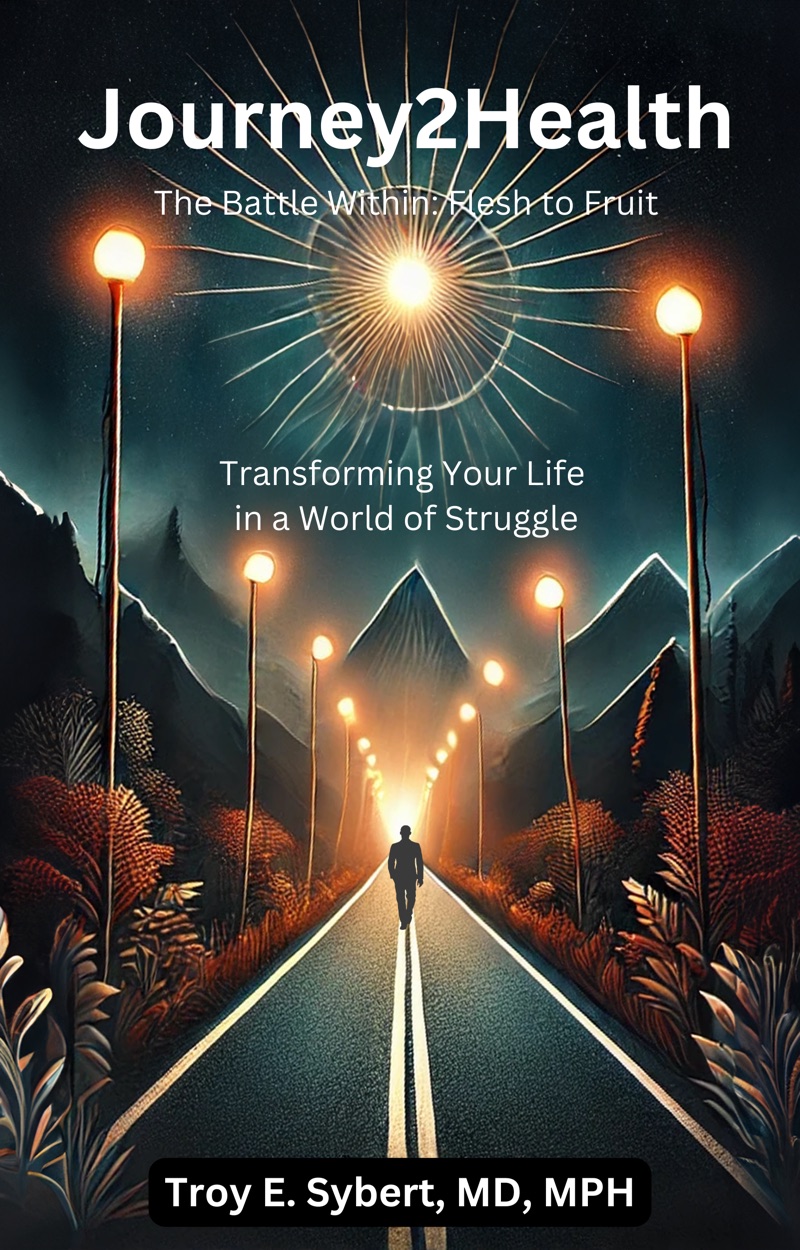
This is the central claim of The Battle Within: Flesh to Fruit, Book 1 of the Journey2Health series. It is out now on Amazon, and the rest of this post is an overview of what is inside and why I wrote it.
Why flesh vs. fruit is more than a spiritual category
Most people who grew up in church can recite Galatians 5:19-23 on autopilot. The works of the flesh. The fruit of the Spirit. Two lists. Memorize them, pick the good one, move on. That is how the passage gets treated in a lot of sermons.
But I am a physician as well as a Christian. I have spent more than two decades inside internal medicine, preventive medicine, and public health. I have watched what chronic anger, jealousy, uncontrolled sexual indulgence, and addiction do to actual human bodies. They do not stay spiritual. They show up as hypertension, cardiovascular disease, immune dysfunction, insomnia, anxiety, depression, metabolic disorder, and early death.
And I have watched the opposite. Patience, kindness, gentleness, self-control, and peace are not abstractions. They are measurable in cortisol, oxytocin, dopamine, and serotonin. They are measurable in resting heart rate and sleep quality. They are measurable in how long a person lives and how well they live while they are alive.
Paul did not know about the HPA axis. He did not run blood panels. But when he listed the works of the flesh and the fruit of the Spirit, he described two physiologies. This book is an attempt to hold those two things together — the scriptural category and the clinical one — and show why they are the same thing seen from different angles.
A walk through the book
The Nature of the Flesh. The first section goes back to the Garden. Genesis 2:7 says the LORD formed the man from the dust of the ground. That is not decorative language. It locates our frailty. The fall in Genesis 3 was not simply eating the wrong fruit. It was an attempt at autonomy. “You will be like God” (Genesis 3:5). Every work of the flesh since then — jealousy, anger, sexual immorality, idolatry, drunkenness, selfish ambition — flows from that same root. The instinct to govern ourselves apart from God. Paul admits the struggle in Romans 7:18: “nothing good lives in me, that is, in my sinful nature. I want to do what is right, but I can’t.”
The Fruit of the Spirit. The second section is the counterweight. Love, joy, peace, patience, kindness, goodness, faithfulness, gentleness, self-control. These are not achievements. They are not nine virtues you muscle into your character by trying harder. Jesus puts it plainly in John 15:5: “Yes, I am the vine; you are the branches. Those who remain in me, and I in them, will produce much fruit. For apart from me you can do nothing.” The branch does not produce fruit by effort. It produces fruit because it is connected to the vine.
The Deeper Dive — Autonomy and Surrender. The third section is where the book slows down and names the actual fight. It is easy to agree in principle that we need to depend on God. It is much harder to live it. Our instinct for independence is not just a habit. It is the exact instinct that drove the fall. The rich young ruler in Mark 10 is one of the clearest illustrations: a man who kept the commandments but could not surrender his wealth. Jesus did not condemn the wealth. He named the dependence. The young man’s trust was in the wrong place. That is the real struggle. Not understanding the need for surrender. Actualizing it, day after day, as an ongoing posture.
Physical and Mental Health Impacts. This is where the clinical part of my life walks on stage. Chronic anger and hostility activate the HPA axis, flood the body with cortisol, drive hypertension, and weaken immune function. Jealousy and envy produce the same cascade. Uncontrolled sexual behavior carries obvious infectious and reproductive risk, and the shame that follows compounds into anxiety and depression. Addiction hijacks the dopaminergic pathway, turning the body’s reward system against itself. Meanwhile, love releases oxytocin. Kindness stimulates endorphins. Joy lifts dopamine and serotonin. Peace lowers cortisol. Patience reduces blood pressure. The body is not neutral in this conflict. It is designed to flourish in one direction and deteriorate in the other. The appendix includes a table mapping each major physiological pathway — dopaminergic, HPA axis, serotonergic, amygdala, prefrontal cortex — to the behaviors that degrade it and the behaviors that restore it.
The Journey to Health. The last section is the call. You can read a book about the flesh and the Spirit and close it unchanged. Information does not transform. Repentance does. Acts 3:19: “Now repent of your sins and turn to God, so that your sins may be wiped away.” That is not one moment at an altar decades ago. It is a daily act of turning. And the principle underneath it is Galatians 6:7-8: “You will always harvest what you plant. Those who live only to satisfy their own sinful nature will harvest decay and death from that sinful nature. But those who live to please the Spirit will harvest everlasting life from the Spirit.” Sowing and reaping is not a metaphor. It is a mechanism.
The clinical bridge
If you are a believer who has never thought of your spiritual life as a medical matter, I am asking you to reconsider. Chronic stress is not a character flaw. It is a biological state, and the Spirit’s work in us regulates that state. Depression is not always, but often, downstream of disconnection — from God, from a community, from the daily disciplines of prayer, scripture, and confession. The prescriptions we write for anxiety and mood disorders will keep you alive. They will not produce joy. Joy is fruit. It grows on a particular vine.
And if you are a reader who comes to this from the medical side and has written off the scriptural language as pre-scientific poetry, I am asking the same of you. The Bible described the physiology of the heart long before the cardiologists did. Proverbs 14:30: “A peaceful heart leads to a healthy body; jealousy is like cancer in the bones.” That is not a metaphor. That is an observation about what envy does to a human being, and modern research keeps catching up to it.
The call to surrender
Running through the whole book is the posture I keep coming back to in my own life. Surrender. Not as a moment of religious intensity but as a daily, ordinary turning. Turning away from the independence that tells me I can manage my own desires, my own appetites, my own reactions. Turning toward the Vine, whose Spirit actually produces the fruit I keep trying to manufacture on my own and cannot.
That is the road less traveled. It is also the only road that leads to the kind of health — spiritual, mental, and physical — that holds up across decades.
Where to go from here
The Battle Within: Flesh to Fruit is available now on Amazon as the first volume in the Journey2Health series. The series will work its way through each fruit of the Spirit, paired with its opposing work of the flesh, and the physiological terrain each one occupies. Future volumes will go deeper on autonomy, relationships, sexual desire and self-control, materialism, chronic disease, stress and anxiety, addiction, forgiveness, and the long-term shape of a healthy life.
If this overview lands for you, the book itself has the scriptural references, the physiological detail, and the personal stories that this post only gestures at. For more on the series and links to each volume as they release, see the book page. For everything else — essays, sermons, and songs — you are already here.
The path you choose makes all the difference.